

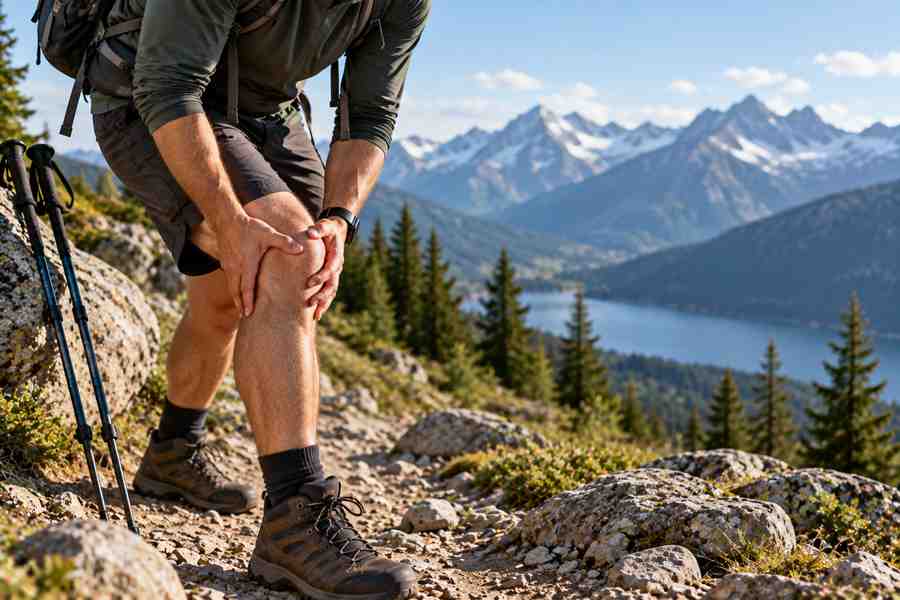
If you’ve ever finished a long trek with sore knees, you may have wondered whether all those kilometres and steep descents are slowly damaging your joints.
It’s an understandable concern.
Trekking involves thousands of steps, uneven ground, steep climbs, and often long downhill sections. Add a heavy backpack and several hours on your feet, and your knees are certainly doing more work than they would during an ordinary day.
But there’s an important difference between putting stress on a joint and damaging a joint.
Current evidence does not support the idea that ordinary walking or exercise automatically wears out your knees. In fact, exercise is an important part of managing knee osteoarthritis, and research increasingly supports regular physical activity rather than avoiding movement altogether.
So what’s actually happening when your knees hurt after a trek?
Your Knees Are Designed to Handle Load
Your knees aren’t fragile hinges that deteriorate simply because you use them.
Everyday activities such as walking, climbing stairs, sitting down, and standing up place loads through the knee joint.
Trekking increases that workload because you’re walking for longer and often dealing with slopes and uneven surfaces.
That doesn’t automatically mean something is going wrong.
A 2025 systematic review and meta-analysis of walking interventions in people with mild-to-moderate knee osteoarthritis found that walking produced minimal-to-no changes in several measures of knee joint loading and concluded that the findings predominantly supported increasing walking without detrimental effects on knee joint health.
That’s quite different from the popular idea that every step is simply “wearing away” cartilage.
Why Do Your Knees Hurt After a Trek, Then?
Because pain and joint damage aren’t the same thing.
After a long trek, your muscles and surrounding tissues may simply be fatigued.
You may also experience temporary soreness after doing significantly more activity than your body is accustomed to.
Downhill walking is particularly demanding because your leg muscles have to control your body as it moves downward. Your knees also experience different loading patterns compared with level walking.
A 2025 systematic review examining knee loading and pain across everyday activities in people with knee osteoarthritis found that walking produced substantial knee loading, while stair climbing was associated with particularly notable pain in the studied population.
This doesn’t mean stairs or downhill walking are inherently harmful.
It means the amount and type of load matter, particularly when someone already has knee problems.
Downhill Is Often the Part Your Knees Notice Most
Ask someone how they felt after a mountain trek and there’s a good chance they’ll mention the descent.
That’s not surprising.
Going uphill is demanding for your cardiovascular system and leg muscles. Going downhill adds a different challenge: your muscles must repeatedly control your body as it moves downward.
This can leave your thighs feeling surprisingly sore.
It’s also why a trek that looks manageable on paper can feel much harder on the way back.
The important lesson isn’t “avoid downhill.”
It’s to understand that the descent is part of the workload when you’re judging whether a trek is appropriate for you.
A Heavy Backpack Changes the Equation
Your body doesn’t experience a trek in isolation.
If you’re carrying 5 kg, that’s one thing.
If you’re carrying 15 kg of water, food, camping equipment and clothing, every step is being taken with considerably more external load.
That doesn’t mean backpacks are inherently bad for your knees.
It means that distance, elevation, terrain and carried weight all contribute to the overall physical demand of a trek.
This is one reason beginners shouldn’t suddenly attempt a long multi-day trek carrying a heavily loaded backpack.
Build up gradually.
Let your muscles and joints adapt to increasing workloads.
Is Trekking Dangerous If You Already Have Knee Osteoarthritis?
This is where you shouldn’t rely on a simple yes-or-no answer.
People with knee osteoarthritis aren’t necessarily told to avoid all walking or exercise. Quite the opposite: major clinical guidance recommends exercise as a central part of osteoarthritis management.
A large 2025 BMJ network meta-analysis covering 217 randomized trials and 15,684 participants with knee osteoarthritis found that several forms of exercise improved pain, function, gait performance, or quality of life, with no clear evidence of different safety compared with control across the exercise categories studied.
But that doesn’t mean someone with painful knee osteoarthritis should suddenly attempt a difficult mountain trek.
There’s a big difference between being physically active and choosing a demanding activity that your current knee symptoms aren’t prepared for.
If you already have significant knee pain, swelling, instability, or a diagnosed knee condition, it’s worth discussing your planned activity with a qualified healthcare professional.
More Pain Doesn’t Necessarily Mean More Damage
This is an important distinction for anyone who enjoys trekking.
You can have a sore knee without having caused structural damage.
You can also have structural changes without experiencing severe pain.
That’s one reason it’s difficult to judge what’s happening inside a joint simply by how it feels after one trek.
Don’t diagnose yourself based on soreness after a difficult day.
Instead, pay attention to patterns.
Does the discomfort settle with normal recovery?
Does it repeatedly appear at the same point during every trek?
Is there swelling?
Is your knee giving way?
Are you changing the way you walk because of pain?
Those are more meaningful reasons to take the problem seriously.
Fitness Can Matter More Than People Realize
Sometimes the problem isn’t the trek itself.
It’s the sudden jump in workload.
Someone who normally walks 3,000–4,000 steps a day may decide to do a steep 15-kilometre mountain trek.
Their knees haven’t necessarily become “weak.”
Their entire body simply hasn’t had much opportunity to adapt to that level of activity.
Gradual progression makes more sense.
Increase walking distance.
Introduce hills.
Practice longer descents.
Build leg strength.
Then increase the difficulty of your treks.
Your body is remarkably adaptable when you give it time.
Stronger Legs Can Help
Trekking isn’t just a cardiovascular activity.
Your quadriceps, hamstrings, glutes and calf muscles all contribute to controlling your movement.
Strength training can therefore be useful alongside walking and hiking.
You don’t need a complicated bodybuilding program.
Exercises such as squats, step-ups, split squats and controlled stair work can help develop the strength required for climbing and descending.
The exact exercises and amount of training should be adapted to your ability, particularly if you already have a knee condition.
When Knee Pain Is a Reason to Stop
Normal fatigue and mild post-exercise soreness are different from symptoms that shouldn’t be ignored.
Be more cautious if you experience:
- Significant or worsening pain
- Noticeable swelling
- A knee that repeatedly gives way
- Locking or inability to move normally
- A significant injury or fall
- Pain that changes the way you walk
- Symptoms that don’t settle with normal recovery
Don’t try to prove toughness by pushing through a potentially serious injury.
Turning around is part of trekking.
So, Is Trekking Bad for Your Knees?
For most people, the evidence doesn’t support the idea that trekking or walking simply “wears out” the knees.
Regular physical activity is generally beneficial, and exercise is an established part of managing knee osteoarthritis. Research on walking interventions also doesn’t show evidence of meaningful detrimental effects on knee joint health.
But trekking can be physically demanding.
Long distances, steep descents, uneven terrain, heavy backpacks, and sudden increases in activity can all increase the stress placed on your body.
The answer isn’t to stop moving.
It’s to match the difficulty of the trek to your current capacity and increase the challenge gradually.
Your knees don’t need to be protected from every bit of load.
They need appropriate amounts of activity, recovery, and adaptation.
And if your knees are already giving you persistent problems, don’t use a trekking article as a diagnosis. Get the problem properly assessed before deciding what your next mountain should look like.