







If you’re planning an RV trip, you’ll often see places described as RV parks, campgrounds, RV campgrounds, or RV resorts. The terms can be confusing because there isn’t one universal definition for each.
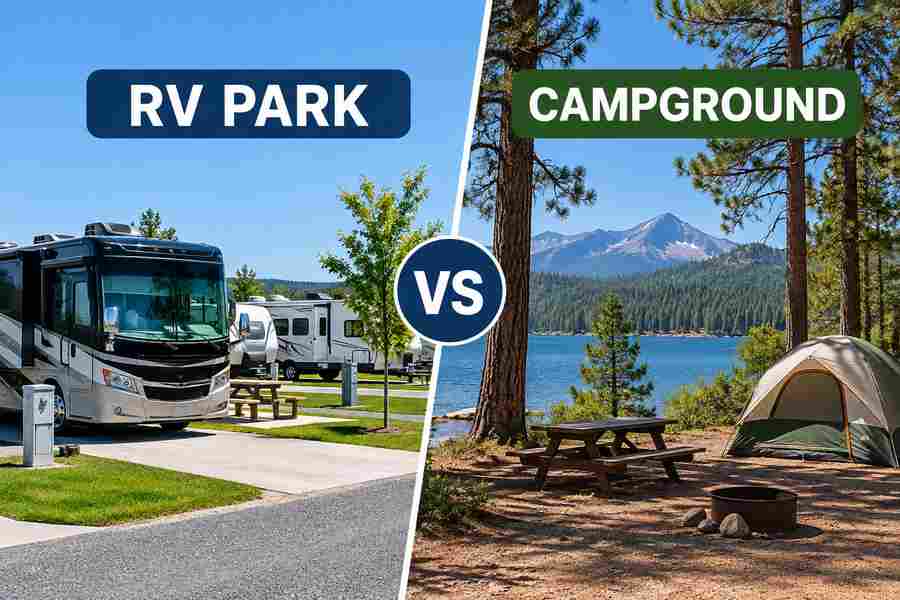
Generally, an RV park is designed primarily for recreational vehicles, while a campground is a broader outdoor destination that may accommodate RVs, tents, or both. But the name alone doesn’t tell you what your stay will actually be like.
What Is an RV Park?
RV parks are generally built around the needs of RV travelers. Sites often have utility hookups and roads designed to accommodate recreational vehicles.
Depending on the property, you might find:
- Electric, water, and sewer hookups
- Dump stations
- Restrooms and showers
- Laundry facilities
- Wi-Fi
- Recreation areas
- Swimming pools or clubhouses
Some RV parks are simple places to stop for the night, while others operate more like resorts with extensive amenities.
What Is a Campground?
A campground is a broader category. It may have tent sites, RV sites, cabins, or a combination of them.
Campgrounds can range from very basic locations with a picnic table and fire ring to highly developed properties with showers, electricity, playgrounds, and recreational facilities.
Many are located near forests, lakes, mountains, trails, or other outdoor attractions.
That’s why two campgrounds can offer completely different experiences.
The Biggest Difference
The biggest difference is often what the property is designed around.
An RV park generally focuses on making RV travel convenient. Hookups, vehicle access, site dimensions, and amenities may be the priority.
A campground may place more emphasis on the overall outdoor experience.
But there is plenty of overlap. A campground can be excellent for RV travel, and an RV park can provide a great outdoor experience.
What Should You Check Before Booking?
Don’t rely entirely on the property’s name. Look at the actual site information.
Hookups: Does the site have electricity, water, sewer, or none of these?
Site size: Make sure your RV fits comfortably, including slide-outs and any tow vehicle.
Access: Check whether the site is pull-through or back-in and whether the roads can accommodate your vehicle.
Facilities: Look at restrooms, showers, laundry, dump stations, and other amenities if they matter to you.
Rules: Check quiet hours, pet policies, generator restrictions, fire rules, and check-in requirements.
Location: Consider whether you want easy highway access or a quieter location close to hiking, water, or other outdoor activities.
Which One Should You Choose?
An RV park may make more sense if convenience, hookups, easy vehicle access, and RV-focused facilities are your priorities.
A campground may be more appealing if the natural surroundings, recreation, or broader camping experience are more important.
For a quick overnight stop, convenience might matter most. For a week-long family trip, the surroundings and available activities may matter much more.
The Bottom Line
RV parks and campgrounds overlap more than their names suggest. An RV park generally focuses more heavily on RV travelers, while a campground can accommodate a wider range of camping styles.
Before booking, look beyond the label and check the site dimensions, hookups, access, facilities, rules, and surroundings.
The best choice isn’t necessarily the place called an “RV park” or “campground.” It’s the one that fits your RV and the kind of trip you’re planning.