


When people talk about hiking in the United States, the same names tend to come up again and again. Yosemite, Yellowstone, the Grand Canyon, Zion, the Smokies and the Rocky Mountains dominate photographs, travel guides and social media feeds. They deserve the attention, but they can also create the impression that America’s great hiking landscapes are limited to a handful of famous places.
They aren’t.
Across the country are enormous forests, forgotten mountain ranges, desert wildernesses, deep canyons and remote valleys that receive a fraction of the attention given to the country’s best-known destinations. Some are protected as national parks, while others sit inside national forests or designated wilderness areas. They may not have the same famous viewpoints or recognizable landmarks, but that can be exactly what makes them interesting.
The Gila Wilderness Feels Like a Different America
In southwestern New Mexico, the Gila Wilderness offers the kind of landscape that many people don’t associate with the state. Instead of the open desert most visitors imagine, the region contains mountain forests, deep canyons, rivers, high ridges and enormous stretches of wilderness.
The Gila has a particularly important place in American conservation history. It was established in 1924 and is recognized by the National Park Service as the world’s first designated wilderness area. Today, it covers more than 558,000 acres and provides extensive opportunities for hiking and backpacking.
What makes the Gila interesting isn’t one spectacular viewpoint. It’s the variety you encounter while moving through it. A trail can follow a river through a canyon before climbing toward ponderosa pine forests and higher ridges. Some routes require river crossings, navigation skills and preparation for changing conditions, making the area feel much more like genuine wilderness than a conventional tourist destination.
The Gila isn’t necessarily easy to reach or straightforward to explore, and that’s part of the attraction. It rewards people willing to spend more time figuring out where they are going rather than simply following a heavily traveled path.
The North Cascades Are Hard to Forget Once You’ve Seen Them
Washington’s North Cascades are another example of a landscape that somehow remains overshadowed by better-known American destinations. The mountains here are dramatic, heavily glaciated and surrounded by forests, lakes and valleys.
The National Park Service describes the North Cascades as some of the finest mountain country in North America, with trails ranging from short walks to steep mountain routes. Higher trails can remain snow-covered well into July or August, and winter access can be limited by heavy snowfall and road closures.
That seasonal difficulty is part of what gives the region its character. A summer hike can take you through dense forest, open wildflower meadows and rocky alpine terrain before reaching views of glaciers and sharp peaks. The Hidden Lake Trail, for example, climbs 2,900 feet over roughly 4.5 miles to the lookout, passing through forests, meadows and rocky slopes along the way.
There are also places here where the feeling of remoteness becomes the attraction itself. The northern part of the park has a low trail density and large areas of unbroken wilderness, while the isolated community of Stehekin has no road connection to the outside world.
The Ouachita Mountains Don’t Look Like the West
The American West gets much of the attention when people imagine serious hiking, but the Ouachita Mountains of Arkansas and Oklahoma offer a completely different experience.
There are no enormous desert cliffs or glacier-covered peaks here. Instead, the landscape is built around forested ridges, streams, valleys and long stretches of green mountain country. It is the kind of place where the scenery gradually reveals itself rather than announcing itself from a famous viewpoint.
The Ouachita National Forest contains wilderness areas and extensive hiking opportunities, including the challenging Eagle Rock Loop. The Forest Service describes the loop as a very difficult route with steep terrain, multiple ridges and numerous creek crossings.
That makes the region interesting for another reason: difficulty doesn’t always come from altitude. A trail doesn’t need to reach 10,000 feet or cross a famous mountain range to demand serious effort. Heat, humidity, steep climbs, water crossings and rough terrain can create an entirely different kind of challenge.
Guadalupe Mountains Rise Out of the Desert
West Texas is another place where the landscape can surprise you.
Guadalupe Mountains National Park rises dramatically from the surrounding desert, creating a combination of dry lowlands, canyons, forests and high mountain terrain. The park has more than 80 miles of hiking trails, ranging from easier nature walks to strenuous full-day routes.
One of the most interesting aspects of Guadalupe Mountains is how quickly the landscape changes as you gain elevation. The National Park Service describes routes that move from desert vegetation into canyons, riparian areas and high-country forests. Guadalupe Peak, the highest point in Texas, requires an 8.5-mile round trip with approximately 3,000 feet of elevation gain.
It isn’t the kind of landscape that immediately fits the stereotype of Texas. That’s precisely why it deserves attention.
Some Forgotten Landscapes Aren’t Forgotten at All
The word “forgotten” can be misleading.
Many of these places are well known to hikers, climbers, backpackers and local outdoor communities. They aren’t secret locations waiting to be discovered for the first time.
What has changed is the scale of attention.
A place can be nationally important and still feel obscure to someone who only knows the biggest names in American outdoor travel. The Gila Wilderness doesn’t need to become the next Yellowstone. The North Cascades don’t need to become another Yosemite. Their value comes partly from retaining a different relationship with visitors.
You can arrive somewhere and feel like you’re exploring rather than simply visiting a landmark.
The Best Landscapes Often Require More Effort
There is a pattern running through many of these overlooked destinations. They aren’t always convenient.
A trailhead might be reached by a rough road. A hike might require crossing a stream. Snow may remain on high trails well into summer. Navigation may be more complicated than following a clearly marked path through a popular national park.
The Gila is a good example. The National Park Service recommends carrying appropriate maps because some trails can become difficult to follow due to wildfire effects, monsoons, overgrowth and snowmelt.
That doesn’t mean these places are only for experienced backpackers. It means the experience rewards preparation. The more remote the landscape, the less sensible it becomes to assume that someone else will have solved every problem for you.
There Is Something Different About a Trail Without a Famous Viewpoint
Popular hiking destinations often have a moment everyone is waiting for. You walk for an hour, reach the viewpoint and take the photograph you’ve already seen dozens of times online.
There’s nothing wrong with that.
But less-famous landscapes can change the rhythm of a hike. You might not know exactly when the best view is coming. There may not be a single iconic rock formation that defines the entire journey. Instead, the experience develops gradually as the trail moves through different environments.
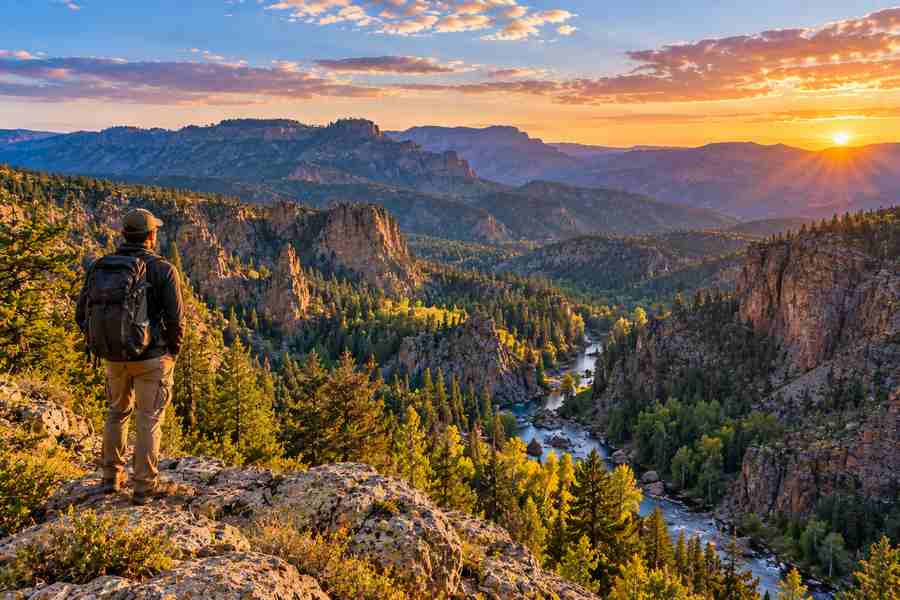
A forest opens into a meadow. A river appears below you. A distant ridge becomes visible between the trees. The trail climbs again and suddenly the landscape stretches out in front of you.
The destination becomes the entire journey rather than one particular photograph.
America’s Hiking Story Is Much Bigger Than Its National Parks
Some of the country’s best hiking experiences exist outside the national parks altogether. National forests, wilderness areas, state parks and other public lands cover enormous areas and contain landscapes that rarely appear on international travel lists.
That’s important because it changes the way you can think about American hiking.
You don’t have to choose between visiting the country’s most famous national parks or staying home. There is a huge middle ground filled with places that offer serious mountains, solitude, wildlife, forests and wilderness without carrying the same level of recognition.
And sometimes that’s exactly what you’re looking for.
Maybe They Aren’t Forgotten—Maybe They’re Waiting
The best thing about these landscapes is that they don’t need a marketing campaign to become worthwhile.
The Gila is still there with its rivers and rugged canyons. The North Cascades still rise above their forests and valleys. The Ouachitas still stretch across Arkansas and Oklahoma. The Guadalupe Mountains still emerge from the desert.
They may not dominate your social media feed, and you may not recognize every trail name when you first hear it.
But that’s part of the appeal.
There is something satisfying about discovering a landscape because you genuinely want to explore it, rather than because you’ve seen the same photograph a hundred times. America has an enormous amount of hiking country, and the famous destinations represent only a small part of it.
Sometimes the most memorable trail is the one you didn’t already know you wanted to walk.