



There are hiking trails where the scenery is the main attraction, and then there are trails where you never quite know what might appear around the next corner. A movement in the trees, tracks in the mud, birds calling somewhere above you or the sudden sight of a large animal across a valley can completely change the way you experience a landscape.
That doesn’t mean wildlife encounters are guaranteed, or that every hike should be treated like a safari. In fact, the best wildlife experiences usually happen when you’re simply moving through an animal’s habitat and giving it enough space to carry on with its life. Across the United States, there are hiking destinations where wildlife is such an important part of the ecosystem that knowing how to share the trail with animals is part of the experience itself.
Yellowstone: Where the Landscape Is Alive
Yellowstone is one of the most obvious places to start because wildlife is deeply connected to the park’s identity. Bison, elk, bears, wolves and other animals live across a landscape that also contains geothermal features, forests, rivers and enormous open valleys.
What makes hiking here interesting is that wildlife doesn’t necessarily appear in a dramatic setting. You might see a herd of bison moving across an open meadow while you’re simply walking between trail sections. An elk may be standing quietly among the trees, or you may notice birds circling above a distant ridge.
The important thing is that Yellowstone isn’t a wildlife park in the traditional sense. These are wild animals living in their natural environment. Their behavior isn’t organized around visitors, and that unpredictability is part of what makes an encounter memorable.
Grand Teton: Wildlife Beneath the Mountains
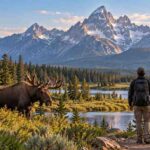
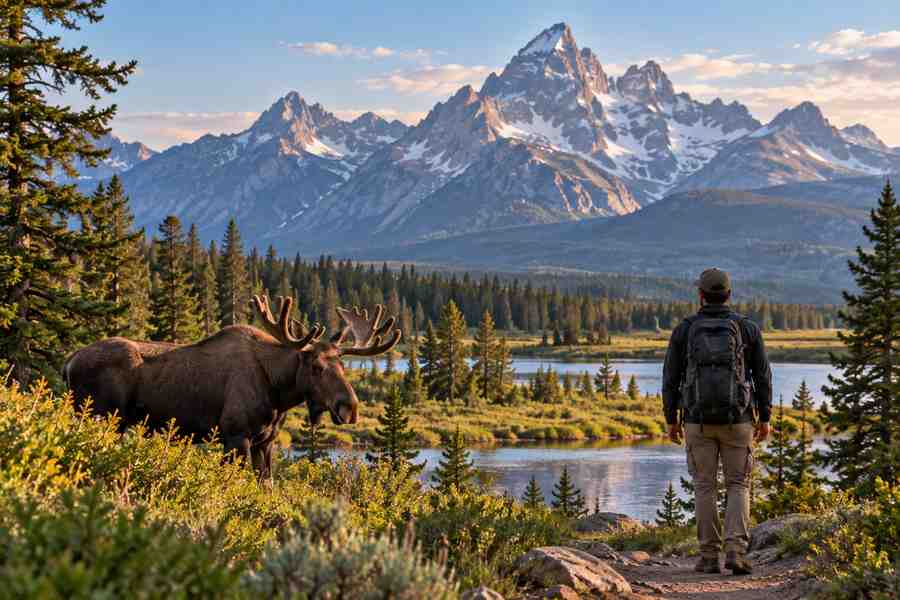
Grand Teton National Park offers a completely different visual backdrop. The sharp peaks of the Teton Range rise dramatically above forests, lakes and broad valleys, while wildlife moves through the same landscape.
Early mornings can be particularly interesting because animals are often active while the day is still cool and quiet. Moose, elk, bison and other wildlife can be encountered in different parts of the park, although seeing any particular animal is never something a visitor should expect.
What makes the experience special is the combination of scale. You might be looking toward a massive mountain one moment and notice a small herd of animals moving through the valley below. The wildlife doesn’t feel separate from the scenery. It is part of the landscape.
Great Smoky Mountains: Listen Before You Look
The Great Smoky Mountains offer a very different kind of wildlife experience. Instead of enormous open valleys where animals can sometimes be spotted from a distance, much of the landscape is heavily forested.
That means you often notice wildlife before you see it.
A rustle in the leaves, a bird calling from somewhere in the canopy or movement in dense vegetation can make you stop walking for a moment. Black bears are among the animals that attract considerable attention in the park, but the ecosystem contains a much wider variety of wildlife, including deer, wild turkeys, salamanders and numerous bird species.
The dense forest changes the psychology of a hike. You aren’t constantly scanning a huge landscape for animals. Instead, you’re moving through an environment where something could be nearby without being immediately visible.
Olympic: Where Several Worlds Meet
Olympic National Park is unusual because a single trip can take you through several dramatically different environments. There are temperate rainforests, rugged coastline, alpine areas and large stretches of protected wilderness.
That variety creates equally varied wildlife habitat.
A hike through the rainforest feels completely different from walking along the coast, and neither resembles the higher mountain country. You might spend one part of the day surrounded by enormous trees and another looking across rocky shoreline toward the Pacific.
Wildlife is part of that broader ecosystem rather than an attraction you have to search for. Birds, marine animals, deer and other species occupy different parts of the park, and sometimes the landscape itself gives you clues that animals are nearby.
Alaska: When Wildlife Changes the Scale of a Hike
If wildlife is an important part of why you enjoy being outdoors, Alaska offers an entirely different level of experience. The state’s enormous protected areas contain landscapes where animals can exist with considerably more room than in many heavily developed parts of the country.
Denali is one of the best-known examples. The park is home to grizzly bears, moose, caribou, Dall sheep and wolves, among other species.
But Alaska also teaches an important lesson about wildlife: seeing a large animal in a remote landscape can be exciting and intimidating at the same time. Distance matters. Terrain matters. Your behavior matters.
The goal isn’t to get the closest photograph possible. Sometimes the most memorable encounter is one where the animal remains far away, completely uninterested in you, while you watch it move through its environment.
The Appalachian Mountains Tell a Different Story
Wildlife encounters don’t always require dramatic wilderness landscapes. The Appalachian Mountains contain extensive forests and protected areas where animals live surprisingly close to popular hiking routes.
The Appalachian Trail passes through a huge variety of habitats across the eastern United States. Hikers may encounter deer, black bears, birds and countless smaller species along the way.
The forest also creates an interesting contrast with the wide-open landscapes of the West. You may hear an animal long before you can identify where it is. Sometimes the experience is nothing more than noticing tracks, scat, feathers or disturbed vegetation and realizing that something passed through the same section of trail before you arrived.
Those small signs are part of wildlife watching too.
Wildlife Doesn’t Have to Be Big to Be Interesting
One mistake people make when thinking about wildlife hiking is focusing only on large mammals.
Some of the most interesting encounters can be much smaller.
A brightly colored bird appearing between branches, a snake crossing the trail, a frog beside a stream or a tiny animal moving through the undergrowth can completely change your attention. Once you stop expecting every wildlife encounter to involve a bear, moose or elk, you begin noticing much more of the ecosystem around you.
This is one reason hiking can be such a good way to experience nature. You’re moving slowly enough to notice things that would be easy to miss from a vehicle.
The Best Wildlife Encounters Are Usually the Quiet Ones
Wildlife doesn’t need to perform for you.
In fact, an animal continuing its normal behavior while you quietly observe from a safe distance can be far more interesting than an animal reacting to a group of visitors.
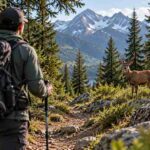
A deer feeding beside a trail, birds moving between trees or a distant bear walking across a hillside are all examples of wildlife behaving normally. The experience becomes less about getting a perfect photograph and more about watching something that existed there before you arrived and will continue living there after you leave.
That requires patience.
It also requires accepting that you may hike for several hours and see almost nothing. That’s not a failed wildlife hike. You’re still moving through an ecosystem full of animals; most of them simply don’t want to be seen.
Sharing the Trail With Wild Animals
Once wildlife becomes part of the experience, your responsibility changes slightly. The trail isn’t just yours.
Giving animals plenty of space is important, particularly with large mammals. Approaching them for photographs, feeding them or trying to attract their attention can change their behavior and create dangerous situations for both people and animals.
Food storage and waste also matter in areas where bears and other wildlife are present. An animal that learns to associate people with food can become a problem for future visitors and may eventually be removed or killed.
The best wildlife encounter is therefore one that leaves no trace behind.
Sometimes You Only Notice the Evidence
Not every wildlife experience involves actually seeing an animal.
A set of fresh tracks in mud can tell you that something passed through recently. Scratches on a tree, feathers on the ground or hoof prints beside a stream can reveal that the trail is being used by animals even when they are nowhere in sight.
Once you start paying attention to these signs, a familiar hiking trail can feel completely different.
You’re no longer seeing just a path through the forest. You’re seeing a route that other species use too.
The Trail Becomes More Interesting When You Stop Expecting a Sighting
That’s probably the biggest difference between hiking somewhere known for wildlife and simply going out looking for animals.
If you spend the entire hike thinking about whether you’ll see a bear or a moose, you may miss everything else happening around you. The changing vegetation, bird calls, animal tracks and subtle movements in the forest are all part of the same experience.
Wildlife is at its most interesting when it feels like part of the landscape rather than an attraction placed there for visitors.
You might finish a hike without seeing a single large animal and still have spent the entire day surrounded by wildlife.
And sometimes, when you least expect it, you’ll look across a meadow or around a bend in the trail and realize that you’re sharing the landscape with something that was there long before you arrived.