
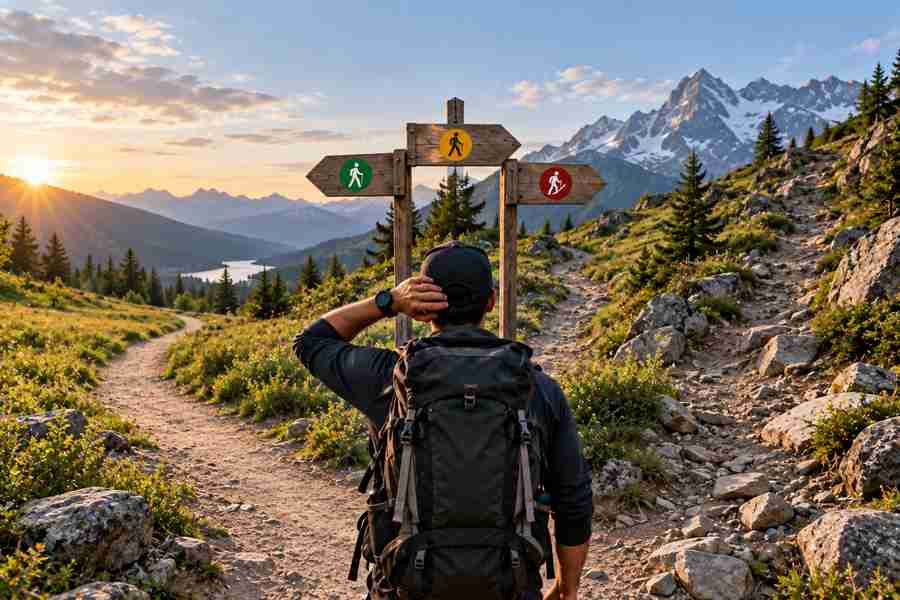
Choosing your first trek can be surprisingly difficult.
A trail might be described as “easy” online, while someone who doesn’t regularly exercise finds it exhausting. Another trek might look intimidating because of its distance but turn out to be manageable because the trail is relatively flat.
The problem is that trek difficulty isn’t determined by one number.
Distance, elevation gain, terrain, duration, weather, altitude, and the weight you’re carrying all affect how difficult a trek will feel.
The good news is that you don’t need to be an expert mountaineer to judge whether a trek is suitable for you. You simply need to know what to look for.
Start With Your Current Fitness, Not Your Ambition
Before choosing a trek, forget about what you want to be able to do.
Think about what you can comfortably do right now.
Ask yourself:
- How far can I walk without significant fatigue?
- Can I comfortably walk for two or three hours?
- How do I handle stairs or uphill walking?
- Do I exercise regularly?
- Have I done any long walks recently?
- How quickly do I recover afterward?
If your normal routine involves very little physical activity, jumping straight into a demanding mountain trek isn’t the best way to start.
That doesn’t mean you can’t become capable of doing harder treks.
It simply means your first trek should give you room to learn.
Don’t Judge a Trek by Distance Alone
This is one of the biggest mistakes beginners make.
A 12-kilometre trek isn’t automatically harder than a 20-kilometre trek.
Imagine two trails:
Trail A: 12 km with relatively little elevation gain on a well-maintained path.
Trail B: 10 km involving several steep climbs, rocky terrain and significant elevation gain.
Trail B could feel considerably harder despite being shorter.
When researching a trek, look beyond the total distance.
Find out the elevation gain — the total amount of climbing you’ll do.
A trail that repeatedly climbs and descends can also be more tiring than a route that gradually gains elevation.
Elevation Gain Matters a Lot
Elevation gain tells you how much climbing is involved.
For example, walking 8 kilometres on mostly flat ground is very different from walking 8 kilometres while gaining several hundred metres of elevation.
You don’t need to memorize complicated formulas.
Just look at the route profile and ask:
“How much climbing am I actually doing?”
If you’re new to trekking, a shorter route with modest elevation gain is generally easier to manage than a short but extremely steep route.
Also remember that elevation gain doesn’t tell the whole story. Two trails with the same elevation gain can feel completely different depending on how that climbing is distributed.
A steady gradual climb is usually a different experience from repeatedly walking up very steep sections.
Consider the Terrain
The surface you’re walking on makes a major difference.
A maintained dirt trail is generally easier to walk on than loose gravel, wet rocks, roots, mud, or steep exposed sections.
Technical terrain requires more than cardiovascular fitness. It demands balance, coordination, careful foot placement, and sometimes confidence with heights.
When researching a trek, look for information about:
- Rocky sections
- Loose gravel
- Mud
- Stream crossings
- Steep climbs
- Steep descents
- Narrow trails
- Scrambling or climbing
A trek with technical terrain may be unsuitable for a beginner even if its distance appears reasonable.
Think About How Long You’ll Be Moving
A trek’s duration can be just as important as its distance.
Walking continuously for six hours is very different from walking for two hours, even if you’re covering the same type of terrain.
Long treks also introduce other challenges:
- Eating enough
- Staying hydrated
- Managing fatigue
- Dealing with changing weather
- Maintaining a steady pace
- Looking after your feet
If you haven’t spent several hours walking before, don’t assume you can simply double your normal walking distance in one day.
Build up gradually.
Your Pace Doesn’t Have to Match Anyone Else’s
Two people with similar fitness levels can have very different trekking speeds.
Don’t choose a trek based on someone else’s completion time.
A group may advertise that a particular trail takes four hours, but that could represent an average pace under specific conditions.
Your actual time may be longer.
That’s fine.
What matters is whether the route is within your capabilities and whether you have enough daylight, food, water, and time to complete it safely.
Weather Can Change the Difficulty Completely
A trek that feels easy in cool, dry weather can become considerably harder in heat, rain, snow, or strong wind.
Hot weather increases fluid requirements and can make climbing feel much harder.
Rain can make rocks and roots slippery and turn dirt trails into mud.
Cold conditions can increase the demands of the trip in other ways.
Before choosing a trek, check the typical conditions for the season you’ll be visiting.
Don’t judge a route solely from photographs taken during perfect weather.
Altitude Is a Separate Consideration
If you’re trekking at high elevation, don’t use low-altitude hiking experience as your only measure of readiness.
Altitude introduces additional considerations, and the body may need time to acclimatize.
A trek that would be physically manageable at low elevation can feel substantially different at altitude.
If you’re traveling from near sea level to a high-altitude destination, research the altitude, acclimatization schedule, and relevant safety guidance before committing to the route.
Don’t Ignore the Backpack
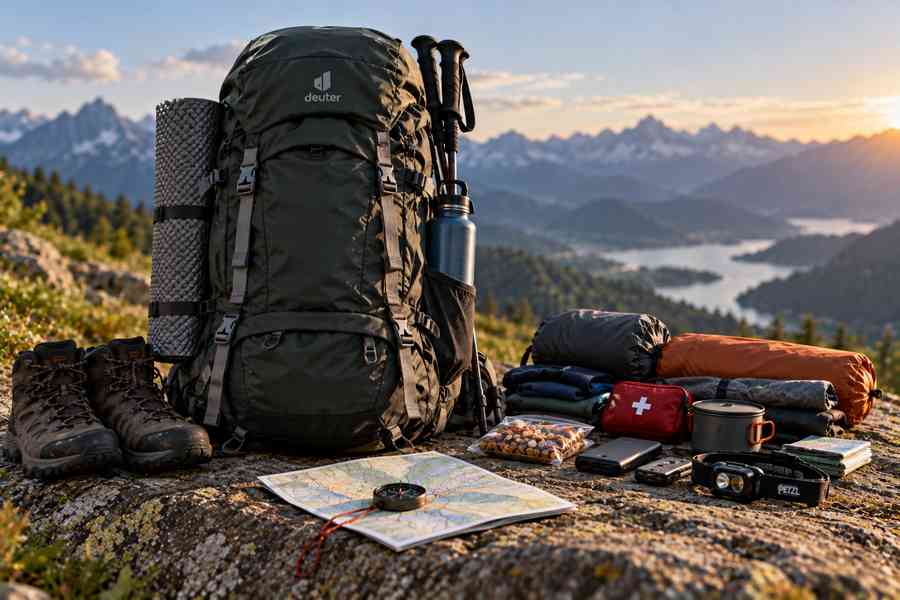
The same trail can feel very different depending on what you’re carrying.
A day trek with a small backpack is one thing.
A multi-day trek carrying food, water, clothing, shelter, and sleeping equipment is another.
When evaluating difficulty, ask whether the published trekking time assumes a light daypack or a fully loaded backpack.
If you’re carrying significantly more weight than the average trekker, expect the route to feel harder.
A Simple Way to Match Trek Difficulty to Yourself
You can think about your options in broad categories.
If You’re Mostly Inactive
Start with a short day trek on a well-maintained trail with modest elevation gain.
Your goal should be learning how your body responds to several hours of walking.
If You Walk or Exercise Regularly
You can consider longer day treks and routes with moderate elevation gain.
Still pay attention to terrain and duration rather than relying on distance alone.
If You Regularly Hike or Train
You may be ready for longer or steeper routes, including overnight trips.
At this point, your preparation should also account for backpack weight, weather, navigation, and recovery.
If You’re Experienced
More demanding terrain, longer distances, higher elevations, and multi-day routes may be appropriate — but each trek should still be evaluated individually.
Fitness doesn’t eliminate environmental risks.
Use a Practice Walk as Your Reality Check
One of the best ways to judge whether you’re ready is to simulate part of the experience.
Before committing to a difficult trek, do a long walk involving hills or stairs.
Carry the approximate weight you’ll have on the actual trip.
Pay attention to how you feel after two, three, and four hours.
Are you still moving comfortably?
Are your feet hurting?
Are you struggling with hills?
How quickly do you recover afterward?
This gives you much more useful information than simply looking at your daily step count.
Give Yourself a Buffer
Don’t choose a trek where you’re barely capable of completing the route under perfect conditions.
Leave some room for unexpected problems.
You might walk slower than expected. The weather might change. The trail could be muddy. You might need additional breaks.
A trek that is comfortably within your ability is usually a much better experience than one where you’re fighting exhaustion from the halfway point.
The Right Trek Should Challenge You — Not Overwhelm You
Your first trek doesn’t need to be the biggest or most difficult route you can find.
A good starting point should give you enough challenge to feel like an adventure while still leaving you with the energy to enjoy the surroundings.
When comparing treks, look at distance, elevation gain, terrain, duration, weather, altitude, and backpack weight together.
Most importantly, be honest about your current fitness.
There is absolutely nothing wrong with choosing an easier trail.
In fact, completing a manageable trek, learning how your body responds, and gradually increasing the difficulty is one of the best ways to become a stronger and more confident trekker.
The goal isn’t to prove that you can survive the hardest trail.
The goal is to choose a trail that lets you enjoy the journey and come back ready for the next one.