








Trekking poles can be used either individually or as a pair, but the two options serve slightly different purposes.
Using two trekking poles can provide better balance, more consistent support, and a more natural walking rhythm. On the other hand, one pole can be perfectly adequate for easier trails or situations where you only need occasional assistance.
So, when should you use two instead of one?
Here’s how to decide.
Why Use Two Trekking Poles?
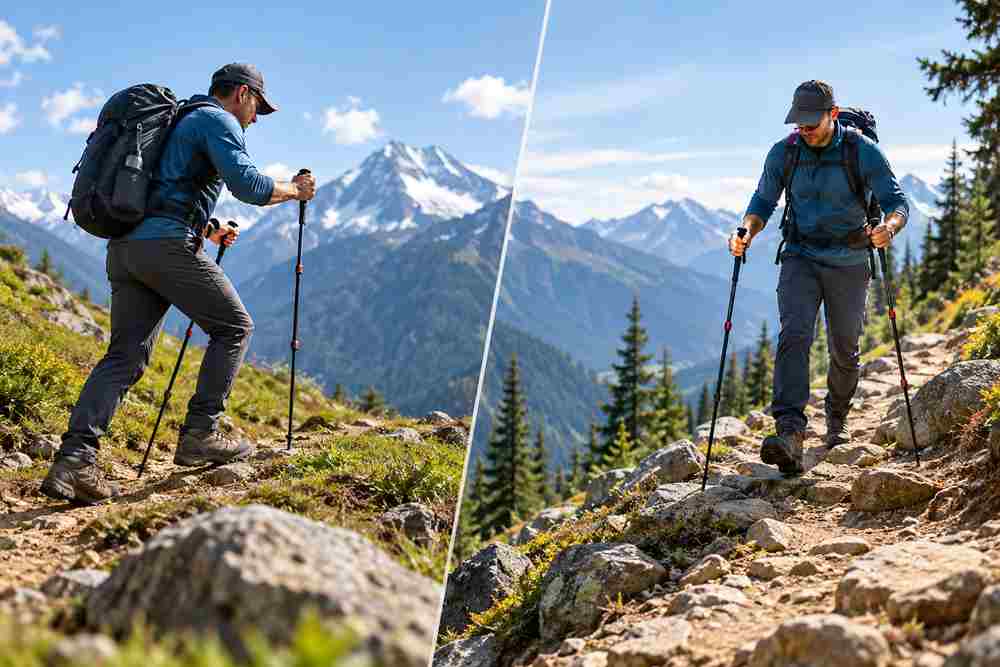
Using two poles gives you two additional points of contact with the ground.
This can be particularly useful when you’re:
- Walking on uneven terrain
- Carrying a heavy backpack
- Climbing or descending steep trails
- Crossing loose gravel or rocky surfaces
- Hiking for several hours
- Walking on muddy or slippery trails
- Looking for better balance and stability
Two poles also allow you to use a more consistent opposite-arm and opposite-leg rhythm, which can make your walking pattern feel more natural.
When Two Poles Make More Sense
1. Steep Uphill Sections
Two poles can be useful when climbing steep trails.
You can plant the poles ahead of you and use them to assist with balance while your legs do the primary work.
Having a pole on each side also helps keep your body more balanced as the trail becomes steeper.
For particularly steep climbs, you may want to shorten the poles slightly so your arms remain in a comfortable position.
2. Long Downhill Sections
Downhill hiking is another situation where two poles can be particularly useful.
A long descent can place considerable stress on your legs, especially when you’re carrying a backpack.
Two poles provide additional points of contact and can help you maintain balance while navigating:
- Loose rocks
- Roots
- Mud
- Uneven steps
- Steep slopes
Extend the poles slightly if necessary and place them ahead of you before taking difficult steps.
Remember that poles provide support—they shouldn’t be used as a reason to rush downhill.
3. Carrying a Heavy Backpack
The heavier your backpack, the more important balance and stability become.
Two trekking poles can provide additional support when you’re carrying camping equipment, food, water, and other supplies.
They can also help maintain a steady walking rhythm during long days on the trail.
If your backpack is heavily loaded, make sure it is adjusted properly before relying on trekking poles. A poorly fitted backpack can still cause discomfort even when you’re using two poles.
4. Uneven or Rocky Terrain
A smooth trail doesn’t require as much assistance from trekking poles.
Rocky terrain is different.
When you’re constantly stepping over rocks, roots, holes, and other obstacles, having two poles gives you additional points of contact.
You can use them to help maintain balance while deciding where to place your feet.
This can be especially helpful when carrying a backpack or traveling over unfamiliar terrain.
5. Wet, Muddy or Slippery Trails
Two poles can also be useful when the trail surface is unpredictable.
Mud, wet rocks, loose soil, and slippery roots can make maintaining your balance more difficult.
With two poles, you can establish additional contact with the ground while carefully choosing your next step.
However, don’t assume that trekking poles will prevent a fall. Pole tips can still slip, particularly on smooth wet rocks.
Good footwear and careful movement remain essential.
When One Trekking Pole May Be Enough
Two poles aren’t necessary for every situation.
One pole may be perfectly adequate when you’re:
Walking on Easy Trails
If you’re walking on a relatively flat, well-maintained trail, you may not need the additional stability of a second pole.
One pole can provide occasional support without requiring you to coordinate two poles.
Taking a Short Walk
For a short hike where you’re carrying little equipment and the terrain is straightforward, one pole may be more convenient.
Looking for Occasional Balance
Some hikers use one pole simply because they like having something to lean on or use for balance occasionally.
In this situation, there’s no need to carry a second pole if you don’t find it useful.
Navigating Areas Where You Need a Free Hand
There are situations where having one free hand can be convenient.
For example, you might need your other hand to:
- Hold a camera
- Read a map
- Adjust equipment
- Hold onto a railing
- Grab rocks or fixed features on appropriate terrain
On technical terrain, however, you should put your poles away if they interfere with safe movement.
Two Poles vs One Pole
| Situation | Two Poles | One Pole |
|---|---|---|
| Flat, easy trail | Optional | Usually sufficient |
| Steep uphill | Very useful | Useful |
| Steep downhill | Very useful | Useful |
| Heavy backpack | Useful | Moderate support |
| Rocky terrain | Very useful | Useful |
| Muddy trail | Useful | Useful |
| Long-distance trek | Useful | Depends on preference |
| Short casual hike | Optional | Usually sufficient |
| Technical scrambling | May get in the way | May get in the way |
Do Two Poles Reduce the Work Your Legs Do?
They can help distribute some of the work across your upper body, particularly when climbing or navigating difficult terrain.
However, trekking poles shouldn’t be treated as a way to completely remove the load from your legs.
Your legs should remain the primary source of propulsion and support.
The main benefits of two poles are balance, stability, rhythm, and additional points of contact.
Are Two Poles Better for Beginners?
For someone learning to use trekking poles, two poles can actually be useful because they allow you to develop a consistent walking rhythm.
However, using two poles also requires some coordination.
Start on easy terrain and practice the basic movement:
Right foot + left pole → left foot + right pole
Once this feels natural, gradually introduce the poles on more challenging terrain.
When Should You Put Both Poles Away?
There are situations where trekking poles aren’t the best tool.
If a trail requires you to use your hands for climbing, scrambling, or maintaining secure contact with the terrain, poles can get in the way.
In these situations, safely stow the poles in your backpack if possible.
You should never allow trekking poles to interfere with your ability to maintain a secure grip or safe position.
What About Using One Pole and Carrying the Other?
You don’t always have to choose between carrying one or using two for the entire trek.
A practical approach is to adapt to the terrain.
For example:
- Easy trail → one or no poles
- Moderate incline → two poles
- Steep descent → two poles
- Flat section → one or two depending on preference
- Technical section → poles stowed away
This can be particularly convenient on trails where terrain changes frequently.
Final Thoughts
There isn’t a universal rule that says every trekker should use two poles.
One pole can be enough for easy trails, short walks, and situations where you only want occasional balance.
Two poles become more useful when the terrain gets steep, uneven, slippery, or demanding, or when you’re carrying a heavier backpack over longer distances.
The best approach is to choose based on the terrain and your own comfort. Practice with both options on easier trails, and you’ll quickly discover when having that second point of support makes a difference.