

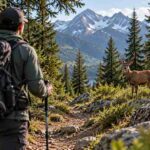
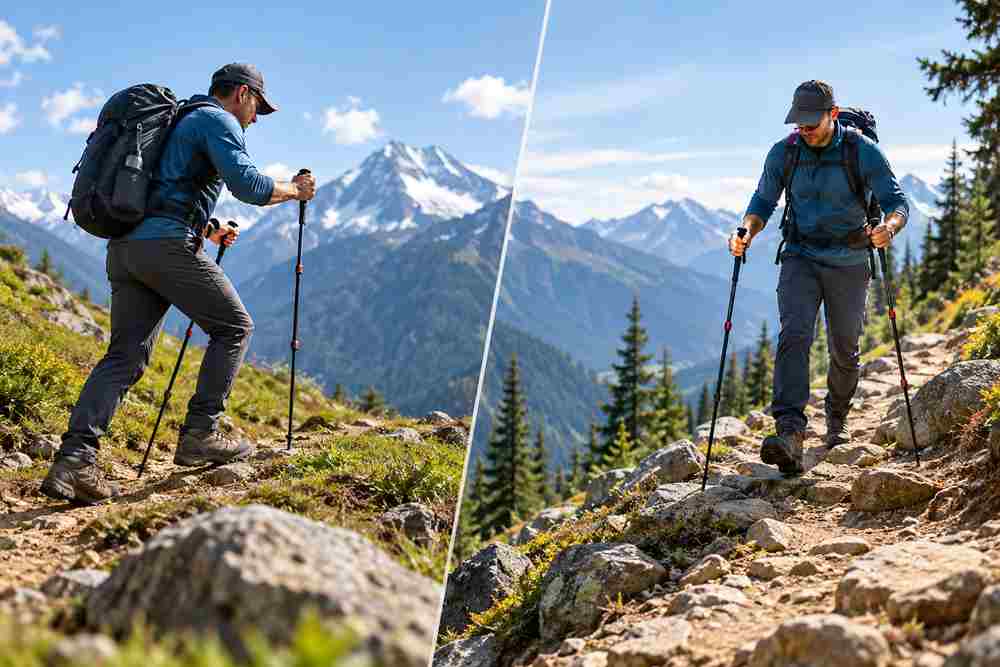
Downhill sections are where trekking poles can be particularly useful.
Descending places more load on your legs, and uneven surfaces can make maintaining balance more difficult.
1. Lengthen Your Poles
You may want to extend your poles slightly for a descent.
The additional length allows you to place the tips farther ahead of you while keeping your body in a comfortable position.
Again, there is no single perfect setting. Adjust them until your posture feels natural.
2. Plant the Poles Before Taking the Step
On a descent, place your poles ahead of you before committing to the next step.
This gives you an additional point of contact with the ground and can help you assess the surface before putting your full weight onto your foot.
This is particularly useful on:
- Loose gravel
- Mud
- Wet rocks
- Uneven steps
- Steep descents
3. Keep Your Steps Controlled
Avoid rushing downhill.
Plant your poles, identify where your foot will land, and take controlled steps.
Your poles should help you maintain balance rather than encourage you to move faster than the terrain allows.
4. Don’t Lean Too Far Back
It can be tempting to lean backward on a steep descent.
Instead, try to maintain a controlled posture with your body balanced over your feet.
Keep your knees slightly bent and allow your legs to absorb changes in terrain.
Using Trekking Poles on Flat Ground
Flat terrain is generally the easiest place to develop your technique.
Keep the poles at a comfortable height and use an alternating movement with your arms and legs.
As one foot moves forward, the opposite pole moves forward.
This creates a natural rhythm:
Right foot + left pole → left foot + right pole
Don’t exaggerate the movement. The poles should move naturally with your walking pattern.
Once this feels comfortable, the same basic movement can be adapted to more challenging terrain.
What About Very Steep Terrain?
When a trail becomes extremely steep or technical, normal pole technique may not always be appropriate.
You may need to:
- Take smaller steps
- Slow your pace
- Plant both poles for additional stability
- Use your hands for balance where appropriate
- Put the poles away when they interfere with safe movement
On sections requiring climbing with both hands, scrambling, or careful use of fixed equipment, your poles can become a hindrance rather than a benefit.
Never allow the poles to prevent you from maintaining three points of contact when the terrain requires it.
Should You Use One Pole or Two?
For ordinary trekking, two poles generally provide more balanced support.
Using two poles can help distribute the workload between both sides of your body and provide additional points of contact.
One pole can still be useful in situations where you only need occasional assistance with balance.
The choice ultimately depends on the terrain, your walking style, and what feels comfortable and safe.
Use the Wrist Straps Correctly
The wrist straps aren’t just there to prevent you from dropping your poles.
Place your hand up through the bottom of the strap and then around the grip. This allows the strap to support your hand without requiring you to squeeze the handle constantly.
Avoid tightening the straps excessively.
Your hand should be able to move comfortably, and you should be able to release the pole quickly when necessary.
Common Trekking Pole Mistakes
Using the Wrong Pole Height
Poles that are too long or too short can make your walking technique uncomfortable.
Start with a comfortable position and adjust the length according to the terrain.
Putting Too Much Weight on the Poles
Your poles are there to assist you, not completely support you.
Continue using your legs and maintain proper foot placement.
Planting the Poles Too Far Away
A pole planted too far ahead can disrupt your balance.
Keep your pole placement controlled and appropriate for the terrain.
Walking Too Fast on Descents
Poles aren’t a reason to rush downhill.
Loose rocks, mud, roots, and uneven surfaces can still cause falls.
Never Adjusting the Pole Length
The ideal pole length can change as the terrain changes.
A setting that feels comfortable on flat ground may not be ideal for a steep climb or descent.
Tips for Using Trekking Poles on Different Terrain
| Terrain | Pole Approach |
|---|---|
| Flat trail | Comfortable length and alternating rhythm |
| Steep uphill | Slightly shorter poles and shorter steps |
| Steep downhill | Slightly longer poles and controlled placement |
| Loose gravel | Plant poles carefully for stability |
| Mud | Test the surface before committing your weight |
| Rocky terrain | Focus on precise pole placement |
| Very technical terrain | Consider storing poles if they interfere with movement |
Final Thoughts
Trekking poles are most useful when they become a natural part of your walking technique.
On uphill sections, slightly shorter poles, shorter steps, and a steady rhythm can help you climb comfortably. On downhill sections, slightly longer poles and controlled pole placement can provide additional balance and support.
The most important thing is not to rely on the poles blindly. Pay attention to the trail, adjust your technique to the terrain, and slow down when conditions become difficult.
With a little practice on easier trails, you’ll develop a natural rhythm that makes trekking poles feel less like extra equipment and more like an extension of your walking movement.