






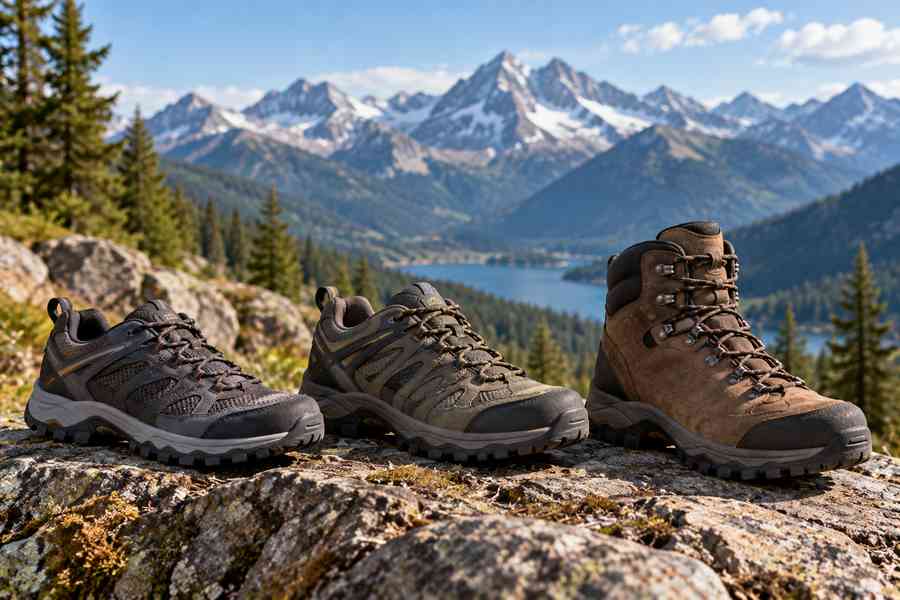
When you’re shopping for your first pair of outdoor footwear, you’ll quickly come across terms like hiking shoes, trekking shoes, hiking boots, and trekking boots.
It can get confusing.
The important thing to know is that these names aren’t used consistently across every brand. A shoe marketed as a “trekking shoe” by one company might be almost identical to another company’s hiking shoe.
Instead of focusing too much on the label, look at what the footwear is actually designed to provide: grip, protection, stability, weather resistance, and comfort for the terrain you’re walking on.
Here’s how to make sense of the differences.
Hiking Shoes: Lightweight and Flexible
Hiking shoes are generally the closest thing to a rugged outdoor shoe.
They look somewhat like running shoes but usually have a more protective upper and a more aggressive outsole.
They’re particularly useful for:
- Day hikes
- Well-maintained trails
- Short to moderate-distance treks
- Warm-weather hiking
- People who prefer lightweight footwear
The biggest advantage is weight.
A lighter shoe can feel noticeably better after several hours of walking, particularly when you’re moving quickly or covering relatively easy terrain.
The trade-off is that hiking shoes generally provide less protection than heavier boots.
If you’re mostly walking on established trails without a heavy backpack, you may not need anything more substantial.
Trekking Shoes: The Middle Ground
“Trekking shoe” is a term you’ll see frequently, but there isn’t one universal definition.
Many trekking shoes sit somewhere between lightweight hiking shoes and traditional hiking boots.
They may have:
- More aggressive outsole patterns
- Stronger toe protection
- More supportive midsoles
- More durable uppers
- Better protection from rough terrain
Some are low-cut like normal shoes, while others have slightly higher collars.
This makes them useful for people who want additional protection without moving all the way to a heavy boot.
For many recreational trekkers, this middle ground can make a lot of sense.
Hiking Boots: More Protection and Structure
Hiking boots generally provide a more substantial construction than low-cut hiking shoes.
They may have stiffer soles, more protective uppers, and higher ankle coverage.
They’re useful when you’re dealing with:
- Rough or rocky terrain
- Longer multi-day trips
- Heavy backpacks
- Colder conditions
- Muddy or wet trails
- Terrain where additional foot protection is valuable
The downside is weight.
A heavier boot requires more effort to move over thousands of steps, and it can feel unnecessarily bulky on an easy trail.
That’s why “more rugged” doesn’t automatically mean “better.”
A heavy boot on a simple day hike can be just as inappropriate as a lightweight shoe on extremely rough terrain.
Does a Higher Ankle Mean More Protection?
This is one of the biggest misconceptions about hiking footwear.
Many people assume that a high-cut boot automatically prevents ankle injuries.
It isn’t that simple.
A higher collar can provide additional coverage and may feel more supportive, but your footwear choice doesn’t eliminate the risk of twisting an ankle.
Traction, terrain, footwear fit, walking technique, fatigue, and how much weight you’re carrying all matter.
Don’t buy a boot purely because you believe the extra height guarantees ankle protection.
Grip Matters More Than the Name
Turn the shoe over.
The outsole tells you a lot about what the footwear is designed to handle.
Look for a tread pattern appropriate for the terrain you’ll encounter. Deep and well-spaced lugs can be useful in muddy or loose conditions, while a different tread design may work well on hard-packed trails and rock.
However, aggressive tread isn’t automatically better everywhere.
A very aggressive outsole can be unnecessary on smooth trails and may not perform equally well on every type of surface.
Think about where you’ll actually use the shoe.
Waterproof or Breathable?
You’ll also need to decide whether you want waterproof footwear.
A waterproof membrane can be useful in rainy conditions, wet grass, mud, and cold environments.
But waterproof footwear has a trade-off: it can be less breathable than comparable non-waterproof footwear.
If you’re trekking in a hot and humid environment, your feet may become sweaty even when there’s no rain.
For warm-weather hiking, a breathable shoe may be more comfortable.
For consistently wet or cooler conditions, additional water resistance may be worth the trade-off.
There isn’t a universally correct choice.
Don’t Ignore the Fit
The best hiking shoe in the world is useless if it doesn’t fit your feet.
When trying footwear, wear the socks you intend to use on your trek.
Your heel should feel secure without excessive movement, while your toes should have enough room to move naturally.
Pay particular attention to downhill walking.
Your toes shouldn’t repeatedly hit the front of the shoe when you’re walking down a slope.
Also check for pressure points around the heel, arch, and sides of the foot.
If the shoe feels uncomfortable after a few minutes in a store, don’t assume it will magically become comfortable after ten hours on a trail.
Break Them In Before Your Trek
Don’t take brand-new footwear straight onto a long trek.
Start with short walks and gradually increase the distance.
This gives you an opportunity to discover problems before you’re several kilometres from the trailhead.
Pay attention to:
- Heel rubbing
- Toe pressure
- Hot spots
- Loose areas
- Foot fatigue
- Excessive slipping inside the shoe
If something is wrong, fix the fit or change the footwear before the actual trek.
So Which One Should You Choose?
There’s no single winner.
Your choice should depend on the trek.
| Type | Best suited for | Main advantage |
|---|---|---|
| Hiking shoes | Easy to moderate trails | Lightweight and comfortable |
| Trekking shoes | Mixed or moderately rough terrain | Balance of protection and weight |
| Hiking boots | Rough, demanding or multi-day terrain | More structure and protection |
If you’re doing a short trek on a well-maintained trail, a lightweight hiking shoe may be all you need.
If you’re dealing with rough terrain and carrying a moderate backpack, a sturdier trekking shoe may make more sense.
For demanding terrain, heavy loads, colder conditions, or trips where greater protection is important, a hiking boot may be worth the additional weight.
Don’t Buy More Shoe Than You Need
One of the most common beginner mistakes is assuming that the most rugged-looking footwear is automatically the best choice.
It isn’t.
Your footwear should match your terrain, distance, weather, backpack weight, and personal comfort.
A lightweight shoe that fits perfectly can be a much better choice for an easy trail than a heavy boot that leaves your feet tired.
On the other hand, choosing lightweight footwear simply because it feels comfortable in a shop isn’t wise if you’re heading onto difficult terrain with a heavy pack.
The right question isn’t:
“Which type of trekking footwear is the best?”
It’s:
“What does the trail I’m actually walking require?”
Once you answer that, choosing between a hiking shoe, trekking shoe, or boot becomes much easier.